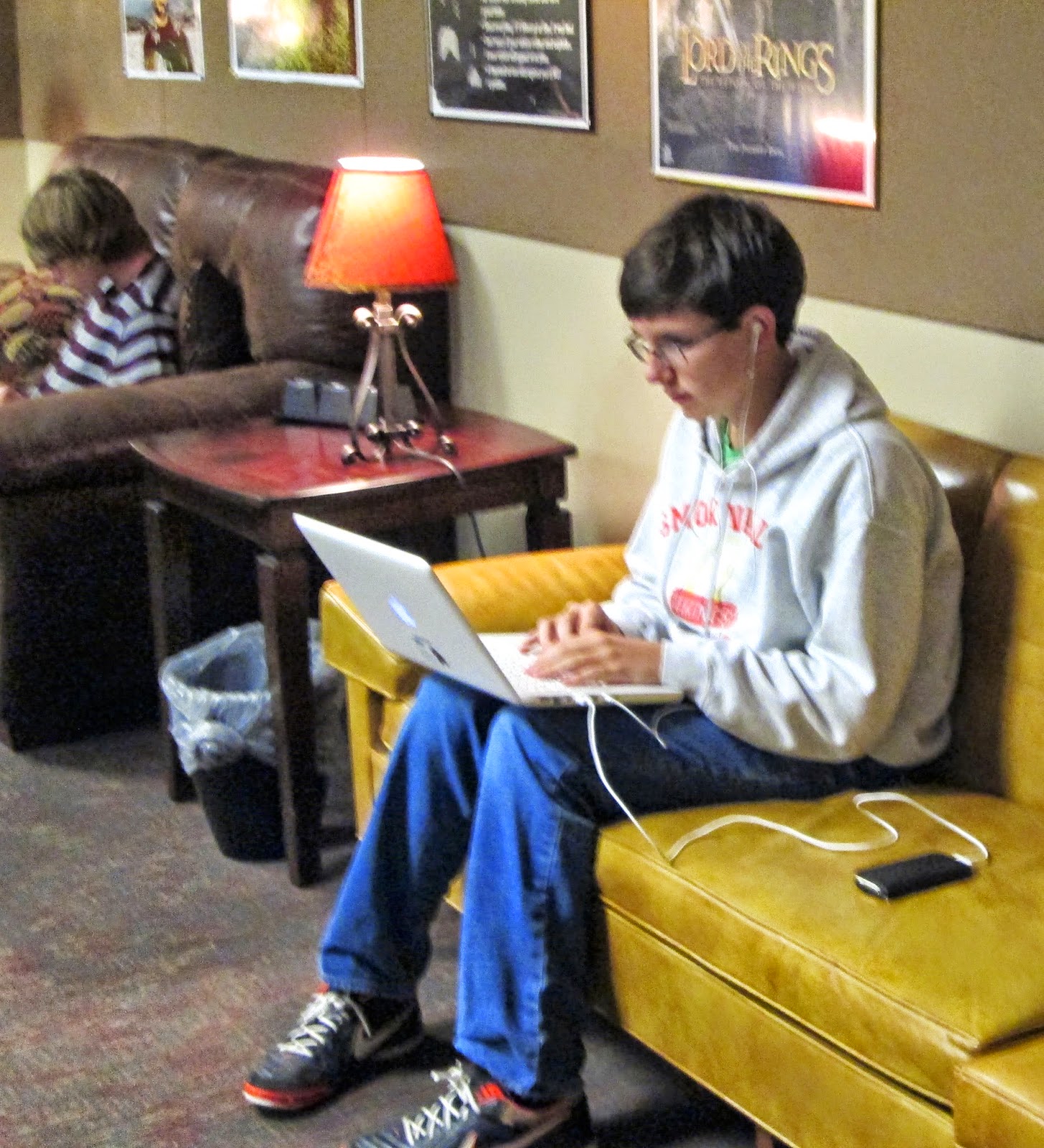
I remember Mrs. Jira, my freshmen English teacher/librarian. You do remember librarians, right? Those unicorn-like creatures that are being eliminated from school systems because ALL they do is check out books....
Okay. So I'm bitter. I am a former librarian....turned technology teacher....turned consultant. I love my job, but I have to poke with my stick every now and then. BACK to topic.
Your librarian taught you some great stuff, and you might not have even noticed. Librarians have been finding things no one else can find for years. So here we are in the Twenty-first Century (living in a world with more information before), and we don't teach people how to FIND things on the Internet. Logical.
Here's a few things EVERYONE should know about finding things on the Internet. Most people "google" information. They type a few things into the Google search engine and peek at the results. Most people only access information they find on the FIRST page of mined results. We are, after all, a busy people who yell "FASTER!" as we stand next to our microwave ovens. Do we find what we need? Sometimes. Mostly, we find what others WANT us to find.
So how do we REALLY glean data using what our librarian taught us? Let's take a mini-lesson, shall we?
Google works on a "natural language" algorithm that selects "key words" from the search string we type. In simple terms, that means that whatever you type in the "search box" for the Google search engine is broken into words to be "searched." For example, if I typed the following into Google:
What is the most popular blog?
The algorithm might pull "popular" and "blog" as key words and bring me results. This type of search can be useful, but when doing specific reference searching, it will gather generic results or thousands of references that require eons of time to evaluate. What if you have to find something more specific? What if you need to know all of the articles on Apple technology development from the New York Times from 2009-2011? Research is like that....specific....and sometimes unforgiving!
How would you create an entry to FIND something like that? Your librarian called this boolean search tools: AND, OR, NOT, and " ".
site:NYtimes.com Apple OR "Apple Technology" OR "Apple development" 2009...2011
Using this search string, you will get specific results for what you want like the following results:
Isn't that a better fix? What does it all mean?
Here are some search terms you should always know.
OR = One or another
AND = In addition to
" " = Finds specific content
site: = looks within a specific site/domain
inurl: = finds keywords within the URL
intitle: = finds keywords within the title of a site
... = an elipse will find material within a time frame
Feeling "nerdy"? You should! Happy searching! Oh, and THANK you librarian for those boolean search terms!
Flip2Facilitate
Monday, November 26, 2012
Sunday, July 15, 2012
Core Curriculum IS Like Going To War
So did that title catch your attention?
I bet it did. It's rather like beginning an essay with the word "sex" or anything connected to the word "sex." So, using this heading is for a reason. I want to talk about "Core Curriculum." You've heard about it. Your administrators have been tossing it your way, and you've been examining it in your professional learning communities. You either have a grasp of the changes heading your way, or you don't. I am one of those in the first category. Hence the title. Core Curriculum will change the way we teach. If it doesn't, we're not doing it correctly. That's why it's like war. Tell a large group of committed stakeholders that all of their lives must change and there will be chaos, pure and simple. Some are excited, others are fearful. Some are angry, others simply plan to do nothing at all. So for those of you who know nothing of the changes to come, here are my thoughts on this "war," I mean "change."
Core Curriculum
1. It will open with a lot of flag waving and hoopla. Get prepared. There will be song singing and flag waving. Inspirational speeches will be given. You will feel something. All wars begin this way. Be prepared for it. There's nothing wrong with flag waving. Heck, I still cry during the national anthem when it's played for those who win medals at the Olympics.
2. Everyone will react differently when the shooting begins. You know that when we "pull the trigger" and begin implementation, everyone will react differently. Some will charge into the front lines, yelling fiercely, "Charge!" Some will be confused, milling about, shouting for help. Some will run the other way, fearful. Some will simply stand still, hoping that they go unnoticed in the uproar. Which will you be?
3. After the battle begins, your awareness awakens. It's going to be bloody. It's going to be hard. You are going to win some things and lose some things. More than that is the knowledge that when you come out on the other side, you will never be the same.
4. Be prepared for ugliness. You know the unit you love? The one on dinosaurs or cell division or poetry? Keep in mind that teaching depth of knowledge takes time, more time than you have ever invested before. That means that some of the things you love have to go. Let's call this war event---amputation. Grim business, eh?
5. When the war is over, you will be tired, but you will have a whole new perspective. I think that says it all.
Our implementation of Core Curriculum will be a battle. Like most wars, there is no way to predict the battles we will will fight or how we will fight them until we actually just DO. We will be changed, but all is for a reason: we fight to create the best possible education for the students placed in our classrooms.
For them, I will do battle.
I bet it did. It's rather like beginning an essay with the word "sex" or anything connected to the word "sex." So, using this heading is for a reason. I want to talk about "Core Curriculum." You've heard about it. Your administrators have been tossing it your way, and you've been examining it in your professional learning communities. You either have a grasp of the changes heading your way, or you don't. I am one of those in the first category. Hence the title. Core Curriculum will change the way we teach. If it doesn't, we're not doing it correctly. That's why it's like war. Tell a large group of committed stakeholders that all of their lives must change and there will be chaos, pure and simple. Some are excited, others are fearful. Some are angry, others simply plan to do nothing at all. So for those of you who know nothing of the changes to come, here are my thoughts on this "war," I mean "change."
Core Curriculum
1. It will open with a lot of flag waving and hoopla. Get prepared. There will be song singing and flag waving. Inspirational speeches will be given. You will feel something. All wars begin this way. Be prepared for it. There's nothing wrong with flag waving. Heck, I still cry during the national anthem when it's played for those who win medals at the Olympics.
2. Everyone will react differently when the shooting begins. You know that when we "pull the trigger" and begin implementation, everyone will react differently. Some will charge into the front lines, yelling fiercely, "Charge!" Some will be confused, milling about, shouting for help. Some will run the other way, fearful. Some will simply stand still, hoping that they go unnoticed in the uproar. Which will you be?
3. After the battle begins, your awareness awakens. It's going to be bloody. It's going to be hard. You are going to win some things and lose some things. More than that is the knowledge that when you come out on the other side, you will never be the same.
4. Be prepared for ugliness. You know the unit you love? The one on dinosaurs or cell division or poetry? Keep in mind that teaching depth of knowledge takes time, more time than you have ever invested before. That means that some of the things you love have to go. Let's call this war event---amputation. Grim business, eh?
5. When the war is over, you will be tired, but you will have a whole new perspective. I think that says it all.
Our implementation of Core Curriculum will be a battle. Like most wars, there is no way to predict the battles we will will fight or how we will fight them until we actually just DO. We will be changed, but all is for a reason: we fight to create the best possible education for the students placed in our classrooms.
For them, I will do battle.
Thursday, July 5, 2012
The Importance of Socialnomics and Social Media as Instructional Content
Social media, social networking and "socialnomics" are mainstays in today's business world. Those businesses who want to stay ahead of the curve are using social media tools to tap into the Internet network to launch campaigns, entice customers, and recruit employable talent.
What are schools doing?
Blocking these sites with filters.
If we don't teach our students who will? We need to teach our students the following: 1) How to use social media as a tool. 2) How to protect one's self while using social media. 3) How to leverage information and data in social media, and 4) How to use social media to make positive connections with the world of work. That means we as teachers have to be social media experts. Most teachers fear this task. Fear no more. We must wade into the social stream and navigate its depths. It is our job to protect, educate, and enlighten our students. Since common core curriculum emphasizes "college and career readiness" as outcomes, we must take into account all aspects of this outcome. Dealing with real world readiness is part of this recipe. Where to do this? I believe that library media specialists can deliver this information quite well. It should be integrated into web literacy lessons. Problem: many schools have eliminated library media specialists. (I am one of these people!) Thus, educators, where do we teach web literacy? I now have that task in my new role, but it is a task that we all should address. Our students' literacy is at stake.
What are schools doing?
Blocking these sites with filters.
If we don't teach our students who will? We need to teach our students the following: 1) How to use social media as a tool. 2) How to protect one's self while using social media. 3) How to leverage information and data in social media, and 4) How to use social media to make positive connections with the world of work. That means we as teachers have to be social media experts. Most teachers fear this task. Fear no more. We must wade into the social stream and navigate its depths. It is our job to protect, educate, and enlighten our students. Since common core curriculum emphasizes "college and career readiness" as outcomes, we must take into account all aspects of this outcome. Dealing with real world readiness is part of this recipe. Where to do this? I believe that library media specialists can deliver this information quite well. It should be integrated into web literacy lessons. Problem: many schools have eliminated library media specialists. (I am one of these people!) Thus, educators, where do we teach web literacy? I now have that task in my new role, but it is a task that we all should address. Our students' literacy is at stake.
Wednesday, June 27, 2012
Why Project-Based Learning IS "Best Practice" Education
"By better integrating academic, career and technical education, and work-based learning, the nation’s secondary schools can increase student engagement, boost student achievement, and provide students with more options after they graduate from high school, according to a new policy brief from the Alliance for Excellent Education."
---from Alliance for Education
We all want to prepare our students for the future, a future we cannot see. We want our education to be work relevant and we aspire to make our assessments authentic. We are ever more aware of the push for this environment. In my state, Kansas, I am looking at multiple movements in this area: Kansas Common Core Standards and CTE (Career and Technical Education Pathways). I, like many, find myself in this mix. Here's what I know. First, we need to look for methods (and tools) to help us shift accountability of learning from a teacher-based model to a student-learning based model. Please understand, I am not removing the concept of "accountability" from my plate at all. I believe we must share it. When we engage the "stake holders" in education, students are often overlooked; I feel they are the most important "stake holders" of all. Thus, in redesigning my curriculum two years ago, I used project-based education to drive my advanced level courses. Here was my concept:
1. Create individual project-based learning driven by content that engaged individual students.
2. Use self-regulated learning techniques in the process.
3. Use a "learning plan" to drive the process. Students would set goals, search for learning resources, and develop a time flow plan (with my guidance) that would drive the learning.
4. Each week, I monitor the process with progress reports/updates. The student and I evaluate the work flow progress and adjust/modify the plan accordingly.
5. Product output is held accountable to high standards established at the beginning of the process.
6. "Raise the bar" for production by broadcasting product to the public and making the creator the showcase representative on a public stage.
7. Finalize the project by using reflection interventions to help the student evaluate their learning process in a meaningful manner.
Sound easy? It's not. I work LONG hours. I guess you have to trust me on that, but let's just say that this is engaging learning, but it requires a different manner of teaching. I facilitate learning this way; I guide and manipulate my students into making themselves great. It works for my students, and for me, that's what matters most.
---from Alliance for Education
We all want to prepare our students for the future, a future we cannot see. We want our education to be work relevant and we aspire to make our assessments authentic. We are ever more aware of the push for this environment. In my state, Kansas, I am looking at multiple movements in this area: Kansas Common Core Standards and CTE (Career and Technical Education Pathways). I, like many, find myself in this mix. Here's what I know. First, we need to look for methods (and tools) to help us shift accountability of learning from a teacher-based model to a student-learning based model. Please understand, I am not removing the concept of "accountability" from my plate at all. I believe we must share it. When we engage the "stake holders" in education, students are often overlooked; I feel they are the most important "stake holders" of all. Thus, in redesigning my curriculum two years ago, I used project-based education to drive my advanced level courses. Here was my concept:
1. Create individual project-based learning driven by content that engaged individual students.
2. Use self-regulated learning techniques in the process.
3. Use a "learning plan" to drive the process. Students would set goals, search for learning resources, and develop a time flow plan (with my guidance) that would drive the learning.
4. Each week, I monitor the process with progress reports/updates. The student and I evaluate the work flow progress and adjust/modify the plan accordingly.
5. Product output is held accountable to high standards established at the beginning of the process.
6. "Raise the bar" for production by broadcasting product to the public and making the creator the showcase representative on a public stage.
7. Finalize the project by using reflection interventions to help the student evaluate their learning process in a meaningful manner.
Sound easy? It's not. I work LONG hours. I guess you have to trust me on that, but let's just say that this is engaging learning, but it requires a different manner of teaching. I facilitate learning this way; I guide and manipulate my students into making themselves great. It works for my students, and for me, that's what matters most.
Saturday, June 16, 2012
Best Free Tools To Flip Your Classroom
So you want to flip your classroom, but where do you start? I encourage the "sandbox" method: play in it. I am going to list what I feel are some of the best free technology tools out there. I'll tell you what they are and how I use them. Then, it's time for you to play. :-)
Dropbox - Dropbox is a great cloud technology storage tool. It's also cross platform, so moving items between operating systems is a breeze. Simply download the application, install, create an account, and you are on your way. You can create public links from the public folder. Drop a video in the public box, right click (or control click if you're on a Mac) and copy the public link from the video. Send it away for others to view. I actually create folders for all of my students. When they join dropbox, I get more free storage. They drop all of their projects here for me to grade. This is a very helpful tool since many email applications have attachment size limitations. Use the cloud and see how it can help you!
Edmodo - If you are looking to tap into the mobile technology world, this tool will be your best friend. Put your lesson plans online and have updates and text messages sent directly to your students. You can even create online assessments here. All for free.
UStreamTV - With UStreamTV, you can stream video live. Create your own channel and feed it through your Facebook page. I use this to broadcast student presentations. If you want to raise the bar in performance expectations, set up your rubrics and broadcast the performances of your students. I have parents who love that they know exactly what I am talking about when it comes to their student's performances. It's hard to doubt video.
Khan Academy - Here is the origin of flipped classrooms. While I don't use this content personally, I often use the same format when I develop my own content. It's great stuff.
TED-ed - TED talks for education. Great Lessons Worth Sharing. Here are great lessons (with extended plans) that you are allowed to flip for YOUR classroom. How great is this? I love it!
These are just a few tools I use. This is enough playtime for today. Be brave and jump in! Remember that everything you do must help you work smarter, faster, and more efficiently. Have a great day in the sandbox!
Dropbox - Dropbox is a great cloud technology storage tool. It's also cross platform, so moving items between operating systems is a breeze. Simply download the application, install, create an account, and you are on your way. You can create public links from the public folder. Drop a video in the public box, right click (or control click if you're on a Mac) and copy the public link from the video. Send it away for others to view. I actually create folders for all of my students. When they join dropbox, I get more free storage. They drop all of their projects here for me to grade. This is a very helpful tool since many email applications have attachment size limitations. Use the cloud and see how it can help you!
Edmodo - If you are looking to tap into the mobile technology world, this tool will be your best friend. Put your lesson plans online and have updates and text messages sent directly to your students. You can even create online assessments here. All for free.
UStreamTV - With UStreamTV, you can stream video live. Create your own channel and feed it through your Facebook page. I use this to broadcast student presentations. If you want to raise the bar in performance expectations, set up your rubrics and broadcast the performances of your students. I have parents who love that they know exactly what I am talking about when it comes to their student's performances. It's hard to doubt video.
Khan Academy - Here is the origin of flipped classrooms. While I don't use this content personally, I often use the same format when I develop my own content. It's great stuff.
TED-ed - TED talks for education. Great Lessons Worth Sharing. Here are great lessons (with extended plans) that you are allowed to flip for YOUR classroom. How great is this? I love it!
These are just a few tools I use. This is enough playtime for today. Be brave and jump in! Remember that everything you do must help you work smarter, faster, and more efficiently. Have a great day in the sandbox!
Thursday, June 14, 2012
The Ever Growing Power of Mobile Technology
Sunday, June 10, 2012
Technology as Savior or Devil
Technology has its buzz words. If you've been in education long enough, you have heard a great many of them: QPA, NCA, Graphic Organizers, Content Area Reading....the list goes on and on. Real veterans...cough...can point to cycles in the jargon. One of the most current in the last decade is the use of technology or one-to-one laptop initiatives. When the initiatives were launched, many looked to computers like a savior. Some wished to claim that use of technology could even boost test scores. Lots of hoopla followed. Fear was also part of the recipe. Often schools divided into two camps: those who supported technology and those who clung to the "days of old." Some saw the new technology as "the devil" in that it corrupted minds, lead students to possible "bad deed," and distracted from classroom teaching. Time has lead to a more middle ground.
I teach technology. I use technology. I advocate for technology.
But like all tools, it clearly has its place.
There are clear reasons for my stand, however. We don't restrict the child from the tool just because the tool "could" be distracting. If such were true, no student would be granted pencils, paper, or those vicious tools: erasers. Can you imagine denying your child the use of the phone or learning how to drive a car? To be without such knowledge would restrict them from finding success in the everyday world we live in. However, there are those who would deny students the use of technology. (Or choose not to use it themselves for the same reasons.) What we all have to remember is that technology is a tool to make us work faster, smarter, and more efficiently. It has changed HOW we learn and WHY we learn that way. The content is still important. What we do in the classroom is still essential. However, we cannot deny its existence or our relationship with it.
Embrace the technology. It is your friend. Oh, and I love my iPhone. ;-)
Subscribe to:
Posts (Atom)